

FAQ
Questions, answered.
The things most people want to know before they book. About the work, the process, and what to expect.
THE ESSENTIALS
What happens in the first consultation?
At first, we just have a brief chat, I want to know how you’re doing today, how you found me, and what your goals and needs are for this work. Then we do some hands‑on mapping. From the moment my hands are on you, two things are happening at once. I'm reading your body, acclimating to how your nervous system responds, feeling for tissue textures and the quiet rhythms underneath, testing ranges of motion, palpating to find out where connective tissue has thickened, and mapping the compensation patterns you’ve built up over the years. When something feels like an old injury, I’ll ask about it. “Do you remember when that happened? What was going on?” Piecing that history together is how I tell the difference between the marks an injury left and the patterns your daily life has worn into you. At the same time, something quieter is going on. I’m helping your nervous system learn that it’s safe here, not just reassuring your mind, but settling the deeper layers at a level below thought. Most people relax more than they expected to, without trying. By the end, you’ve been genuinely read and genuinely cared for, and I have a working map of what’s actually going on. Then we have a short debrief about the experience and you go about your day.
Why do you work in programs instead of one-off sessions?
Because the most important changes start below the level you can feel. By the time a pattern has become painful, most people have quietly lost touch with the very sensitivity they’d need to notice it shifting. So in the beginning, real change is happening under the radar. A lot of people come in expecting something dramatic. And here’s the trap: pushing hard enough to make it feel dramatic usually sets progress back rather than forward. So part of the early work is reteaching your body to feel change as it happens, gently, without overwhelming you and letting that change accumulate until it’s unmistakable. There’s a physical clock too, connective tissue remodels slowly. A meaningful shift usually takes three or four months, longer when the patterns are old. Your nervous system, your sensitivity, your movement, and your sense of what you can do for yourself all begin changing much sooner. A single session can genuinely change you. The catch is you often won't know it was the work or how to build on it. Coming back is what makes the change legible. Session to session, I ask the questions that help you notice what shifted, and you start to feel a body that's actually reorganizing, not one that just felt good for an afternoon.
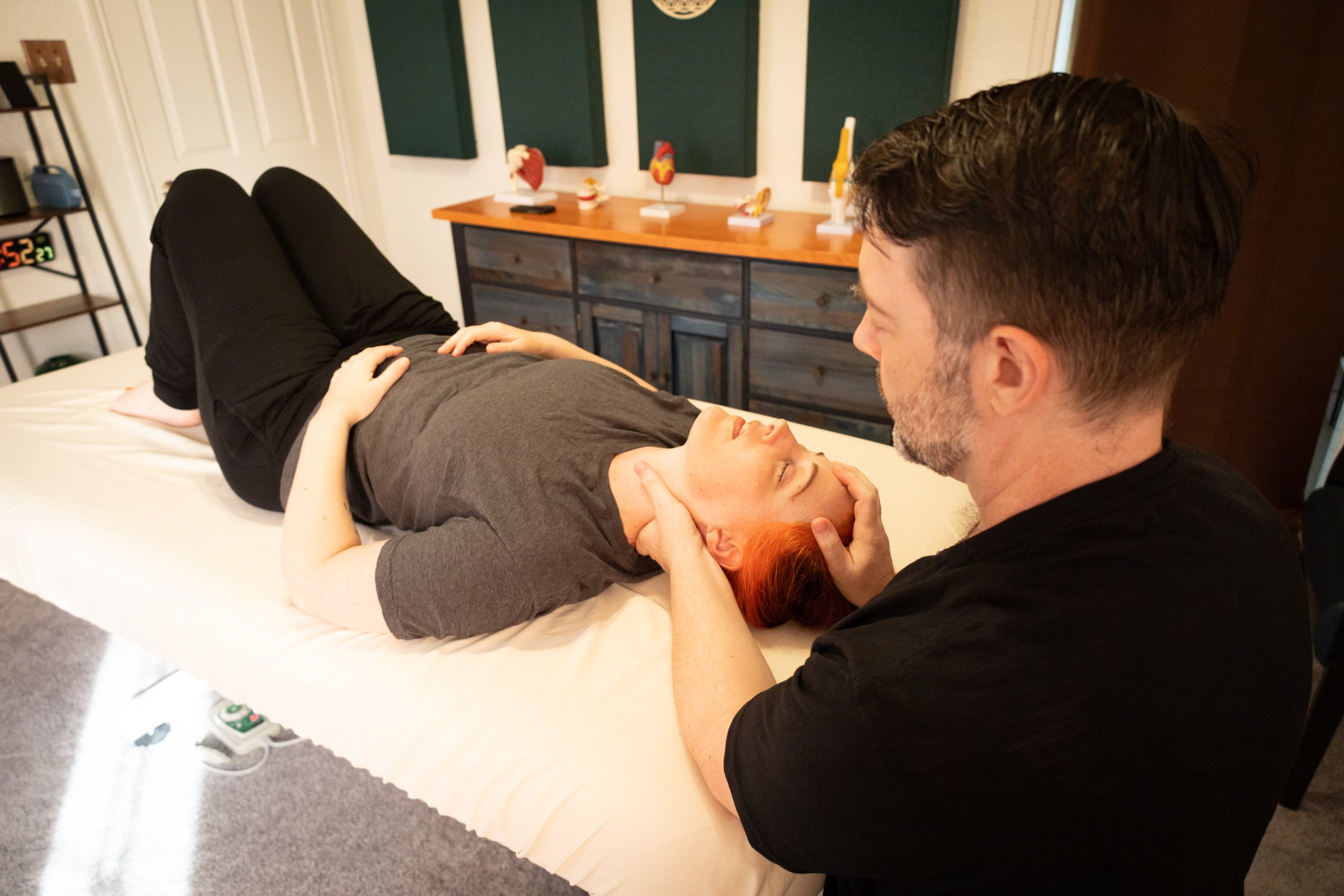
Do I need to undress?
No, you stay clothed in something comfortable you can move in like athletic wear, something stretchy or just loose and comfy. I discovered years ago that most of the time undressing simply isn’t required to do deep therapeutic work. And once I let go of the gowns, the draping and the low‑grade anxiety that comes with the potential for exposure, the work got noticeably deeper. You’re more at ease when you’re clothed and in control of it. And so am I. That ease is part of what lets the real work happen. Staying clothed also means I never have to leave the room, so I don't miss some of the critical moments that tell me the most, how you move getting on and off the table, and how your body and movement patterns adapt in the first few minutes after. Again with the subtlety, but it’s my job to notice the transitions, how your balance and posture adjust in the minute or so after you get off the table tell me a lot. Once in a while, it can be helpful to work on or see the skin directly, the faint differences in tone or texture that tell me where your nervous system is settling or is still bracing, and for that, some clients work in athletic wear like shorts and a sports bra. It’s never something I require of you, and never in a first session. Trust comes first, and the choice is always yours.
Does the work have to be painful?
In a word, no. The work does not have to be painful. In fact, generally speaking, pain should be a contraindication in the therapeutic context. Another way to think about it is that if you feel pain when I’m working on you, or even discomfort, the optimal outcome is for you to tell me something about it, or for me to notice it, and to stop doing what I’m doing, change things up, and figure out how to work on that part of you in a way that doesn’t hurt. Clients and therapists really want to feel like something is being accomplished, and pain or discomfort is often something that they've been conditioned to believe means work is being done. That's not what pain means. Pain means your nervous system doesn’t feel safe with what’s happening right now. Therapeutically, what to do with pain when working is to stop it from happening. To work within your limits instead of crossing them constantly. Crossing those limits, getting acclimated to having those limits crossed over and over and over is actually why people end up in chronic pain. When I find a part of your body that is so sensitive to pressure that it causes discomfort or pain, it’s literally my job to figure out how to change that. So that if that part of your body does need some pressure for you to get better, we can accomplish it without you being conditioned to believe that enduring pain is necessary.
BOOKING & COST
-
When in doubt, 90 minutes. A lot of the work needs enough time to both produce a real change and bring your system back to balance before you leave. Rushing that second part undercuts the results. Ninety minutes gives us room to do both, and it’s what I'd recommend for Foundation work and for anything complex or deep. Sixty minutes is a good fit for lighter work, focused tune‑ups and maintenance once you're established. Not sure? Book 90 or just ask me.
THE WORK ITSELF
-
A wide range — and especially the stubborn, complex ones that you haven’t found sufficient relief with elsewhere.
Musculoskeletal issues:TMJ tension and pain
Carpal tunnel nerve pain
Sciatic nerve pain
Shoulder ROM restrictions
Plantar fascia pain
Acute elbow pain
Repetitive stress injuries
Surgical recovery and prep
Old surgical scar tissue
Old injuries never fully recovered
Systemic challenges:
Chronic and complex pain patterns
Connective tissue pain/tension
Inflammation sensitivity
Coordination challenges
And more
Ergonomics:
Desk work
Driving
Standing jobs
Lifting and moving
Any body mechanics related challenge
Athletic performance:
Endurance sports
Weight lifting
Golfing
Tennis
Pickleball
Really any athletic endeavor
-
My approach Adaptive Remodeling draws on dozens of modalities, chosen specifically for your body during the work rather than running fixed routines. Which ones show up in your sessions depends entirely on what you need.
Myofascial and connective tissue therapies
Structural Integration
Neuromuscular techniques
Movement therapy
Craniosacral
Muscle energy techniques
Positional release
Visceral and abdominal bodywork
Trauma-informed nervous system work
Rhythmic sensory stimulation
Lymphatic drainage
-
Much of what I am doing is a conversation with your nervous system, working face up lets me read and influence how you respond, orient, move, protect and relax far better than having you lay face down for an hour. It also keeps you more of an active participant rather than a passive body being worked on. This does not mean I do not work on the back side of your body. I use an extensive range of techniques where my hands are under you, or one hand is under and the other on top. One of the things I am doing differently is always working in three dimensions, I am attending to your whole body no matter what position you are in. I do work in other positions as necessity dictates, face down, side lying, seated, standing and in context specific positions.
-
This is one of the most common misunderstandings in manual therapy. Depth is not about intensity or how hard I press, it’s about what is being engaged and attended to. The deepest tissues in your body can often be reached with very little pressure. Sometimes the deep structures can only be engaged therapeutically with light pressure, because significant pressure overwhelms your ability to feel things accurately, and much of the work is in the feedback between what I am doing and what you are feeling.
I can and do use significant pressure when it is called for. Often this means doing a lot of delicate and attentive work to prepare you for significant pressure without overloading your nervous system. Modulating the pressure I use to match your tolerances means when something needs a lot of pressure, it will feel comfortable or even good rather than painful.I also check in with you often about how what you’re feeling is shifting. Partly to counter the “intensity means something is happening” assumption, and partly because a lot of people living with pain have lost their sensitivity to how things feel when they change. So the deepest part of the work is often helping you notice what your body is actually doing, that it can change, and that you can be an active part of changing things without pushing yourself to the limit of your tolerances.
-
Much of the change from this work is reinforced by what you do between sessions. You participating in actively changing your patterns of movement and sensation are key to reinforcing our work and making progress in the process of reaching your goals. To ease some of your potential anxiety about this, the movements I give are not demanding of your body, they are demanding of your attention, but only for brief periods of time. Your daily movement prescription will probably only take 10-20 minutes of your day total, split up into 3-4 short sessions of movement you can do anywhere. My corrective exercises are all about precision, working within your tolerances, sensing your body better and attending to the quality of your movement above all else.
Each session includes finding movements that are precise to your body and the progression toward better. It’s not a cookie cutter approach, even when I prescribe movements that are from a general library, I find which ones are for you by assessing whether they help in real time. In most cases the movements I give will have immediate positive impact on your pain or physical functionality. Also, there are many situations where your process will require a specific movement in a very specific position. This is why I do custom videos. Sometimes it is not easy to remember exactly how to do the movements we did in a session. I make sure you can repeat them and get the consistent results by making you customized private instruction videos only you can access. Over time you build up a personal library of the practices that keep you moving well, and it updates with your progress.
EXPECTATIONS & HONESTY
-
I’ll tell you honestly. Some things resolve completely; some we learn to manage so you get the most out of life; and some are lifelong, where the work is about protecting your quality of life. I do not do performative certainty to keep you booking. Mapping what’s genuinely changeable, and being straight about what isn’t, is part of the work. There are plenty of situations in which mitigating the symptoms of a lifelong issue is the best approach. There are situations in which significant change can only occur over a long timeline. I work with anyone that my work actually benefits.
Also, I know I am not a one stop shop for every malady known to human kind, when I run across something I think another practitioner could help you better with, I will let you know and give you my best suggestions for what to try next. I may end up playing a starring role on your care team, have a bit part, or be the person that can help you find a different approach that is best for you. I am not interested in having you come back over and over for something that is not providing value to you. I do not play that game, because it is antithetical to the therapeutic alliance that allows for true change to take place.
-
Often, within the first session or two, feeling change early is part of how foundation works, because you need to feel evidence in your body that change is possible before your body will commit to it. Lasting structural change takes longer, because it comes from how your tissue adapts to changed daily loading, which builds up over weeks, not at a single session. Fortunately, your nervous system is quick to adapt, so a few seemingly minor changes can produce real shifts in how you sense your body, and that can help you feel better fast. Beyond quick relief, my job is to make sense of your specific situation and build a plan for change that reinforces itself through how you move every day. So it holds up in real life, not just for an afternoon. Quick relief and durable change aren't the same thing. I'll often help you feel relief early, but I'm always working towards the second. You feeling and moving better for the long haul.
-
No. DepTherapeutics provides therapeutic massage, body work, and movement education. This work supports your health, comfort, and movement. It does not include the diagnosis or treatment of illness or disease, and it is not a substitute for evaluation, diagnosis, or treatment by a physician or other licensed medical provider. If you're managing a medical condition, please keep your medical team involved.
LOGISTICS
-
I am located in Pflugerville and serve the greater Austin TX area. I currently see people in my home where I have a room dedicated to my practice. You can reach me at marty@deptherapeutics.com or (737) 334-6593
-
For select clients, yes. When leaving home costs you more than the work returns, the work is better done where you live. At-home sessions are 90 minutes and cost an additional $50 per session for locations within a 20 minute drive from my office in Pflugerville TX. If you are further away than that we may be able to make arrangements to meet your needs. These bookings must be arranged by conversation rather than online booking. Reach out to me at marty@deptherapeutics.com or (737) 334-6593 or on my contact page.